



Henry Gordon-Smith
Urban agriculture is no longer a fringe idea. It’s becoming essential infrastructure for cities facing climate disruptions, rising food insecurity and growing urban populations. But if it’s going to deliver on its promise, we need to move beyond the outdated binaries of high-tech vs. low-tech, or community gardens vs. commercial farms.
The truth is: urban agriculture exists on a gradient. At one end are soil-based community gardens that bring food sovereignty and social connection with minimal investment. At the other are fully automated vertical farms with sophisticated climate control. In between lies an often-overlooked array of models—like rooftop greenhouses, engineered-soil commercial rooftops and hybrid community farms using hydroponics in modular systems. These systems serve different purposes— profit, education, environmental remediation or local food access—and each demands its own strategic mix of technology, policy and business logic.
Too often, urban farming ventures have prioritized flashy tech over sustainable business models. In the early days of the vertical farming movement, it was easy to be seduced by glowing LEDs and automation. But the hard truth is that many of these ventures failed to deliver on the bottom line. What investors, governments and communities are really asking now is: does this work long term?
For more than a decade, my company, Agritecture, has worked across 40 countries advising urban agriculture startups, city planners and developers. We’ve learned that technology should follow strategy—not define it. Every project must begin by asking: what’s the core purpose? Is it to improve food access? Provide educational opportunities? Drive economic returns? The answer determines the farm design, the choice of technology and the policy levers needed to support it.
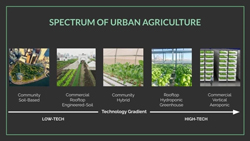 In many cases, we’ve seen mid-tech models — such as rooftop greenhouses — offer a compelling balance of controlled environments and productivity, without the full operational complexity or energy footprint of stacked vertical systems. But their success depends on critical factors: climate suitability, energy prices, rooftop load capacities, and the regulatory environment. There is no universal solution; the key is designing for context. At the same time, community-driven hybrid farms can foster grassroots involvement while still achieving reliable production. The success of any system isn’t about being the most advanced—it’s about being the most appropriate.
Policy also plays a vital role. Cities like Paris, Singapore and Toronto have shown that urban agriculture thrives when zoning reforms, green roof mandates and procurement incentives work together. It’s not about pushing one model, but creating space for many to co-exist. The future of urban food systems will be diverse—and that diversity is their strength.
Urban agriculture should not be treated as an afterthought or a showcase. It should be treated as resilient infrastructure. If we want our cities to withstand the next pandemic, supply chain collapse or climate shock, then we must embed food production in the urban fabric—with purpose, with design and with the right support systems in place. Let’s move past the hype.
Let’s build food systems that last. Urban agriculture doesn’t need more spectacle—it needs smarter models and the courage to rethink what food production can look like in the 21st century city.
